Gustav Briskey
Born 15 February 1828 at Wollin, Prussia. Migrated to Australia in 1876 and later established Bottle Tree Farm near Brymaroo. Lloyd Davies' transcript records 23 children, 17 surviving to maturity.
Our History, Our Stories, Our Legacy
Preserving the photographs, memories and records of the Briskey family for generations to come.
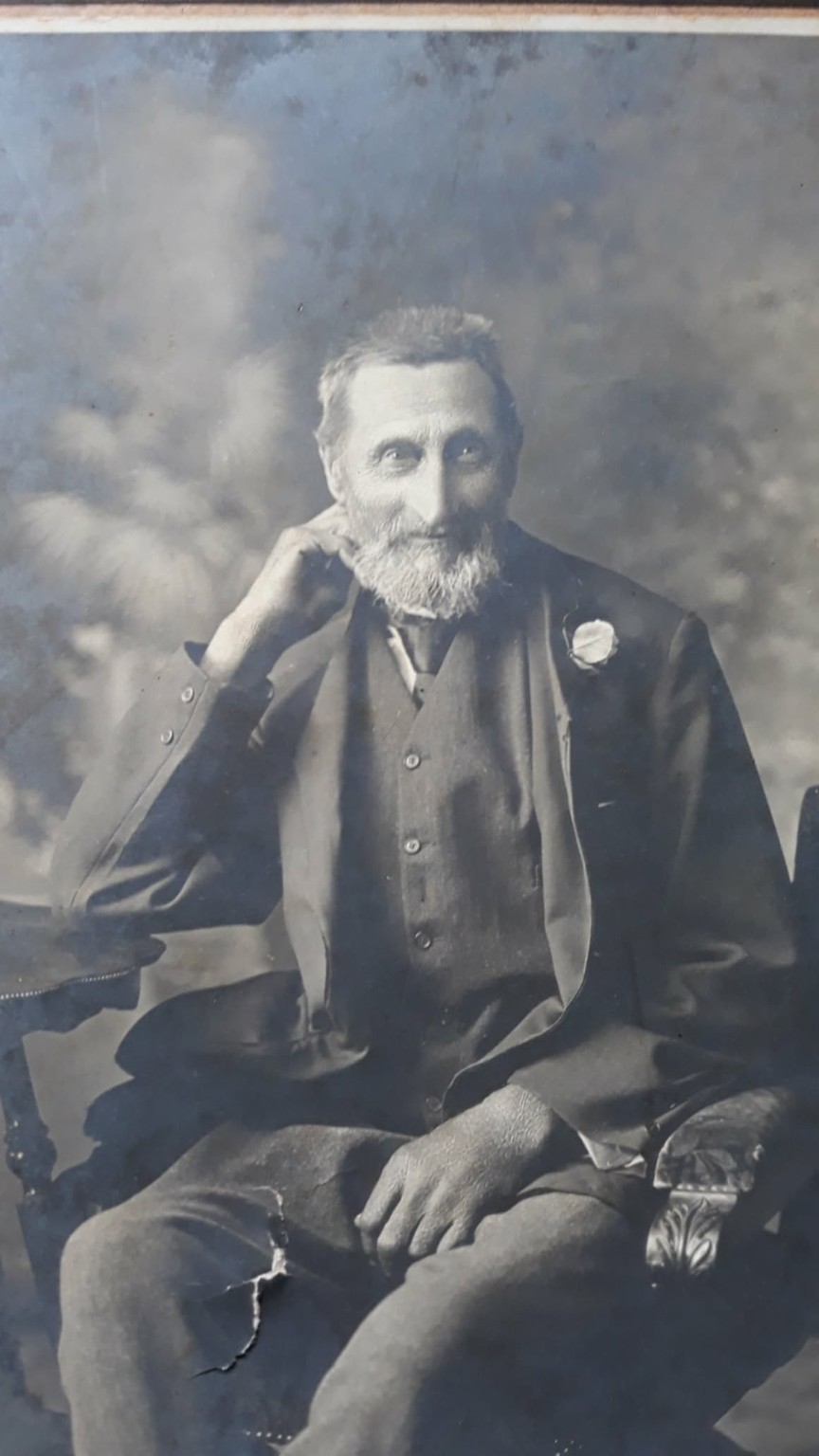
The Lloyd Davies family history records Gustav Theodore Briskey as an early ancestor of the Australian Briskey family.
Gustav was born on 15 February 1828 at Wollin, Prussia, to Georg Brischke and Katharina Schalk. Wollin was a small village near present-day Lebork, close to the Baltic Sea. The family owned a brickworks and, by the standards of the time, were described as reasonably well off.
Gustav married Maria Richter about 1852. They had nine children. After Maria's death following the birth of their ninth child, Gustav later married a 17-year-old servant girl recorded in the transcript as Maria Zishorn/Zuchom ?, who was about 27 years younger than him.
Three other children died as infants and were buried in Germany. The transcript states that Maria died after having her ninth child and was also buried in Germany.
Gustav, Maria No. 2 and his five youngest children sailed from Hamburg on 13 June 1876 aboard the Reichstag. They arrived at Brisbane on 6 October 1876 after a voyage of 115 days.
The family may initially have stayed at German Station, now Nundah, before heading for the Roma district. Gustav found railway work, possibly splitting or laying sleepers for the railway heading west.
The transcript notes that no one named “Briskey” actually arrived in Australia: the surname at Brisbane was Brischke. It suggests the later spelling may have resulted from Anglicisation or an English rendering of the German pronunciation.
The transcript says there were also two unnamed children who died young, and that at least one was buried at Bottle Tree Farm.
In the late 1880s the family moved to Rosalie Plains, a large station north-west of Toowoomba. About 1890 they selected 157 acres, portion 31V, parish of Rosalie, near Brymaroo in the district of Nungil, and named the property Bottle Tree Farm.
Lloyd Davies wrote that a huge bottle tree — measured at 8.1 metres circumference at chest height in 1993 — grew beside the site of the old house. He visited the farm on 7 June 1993, when it was owned by Barry Cauley and his son Scott, and was shown the bottle tree and flattened remains of stone fences believed to have been built by the Briskeys.
A family recollection independently remembers visiting Lloyd Davies more than 30 years ago with cousin Sue and being taken to Bottle Tree Farm, where the huge bottle tree and remains of old stone fences were still visible.
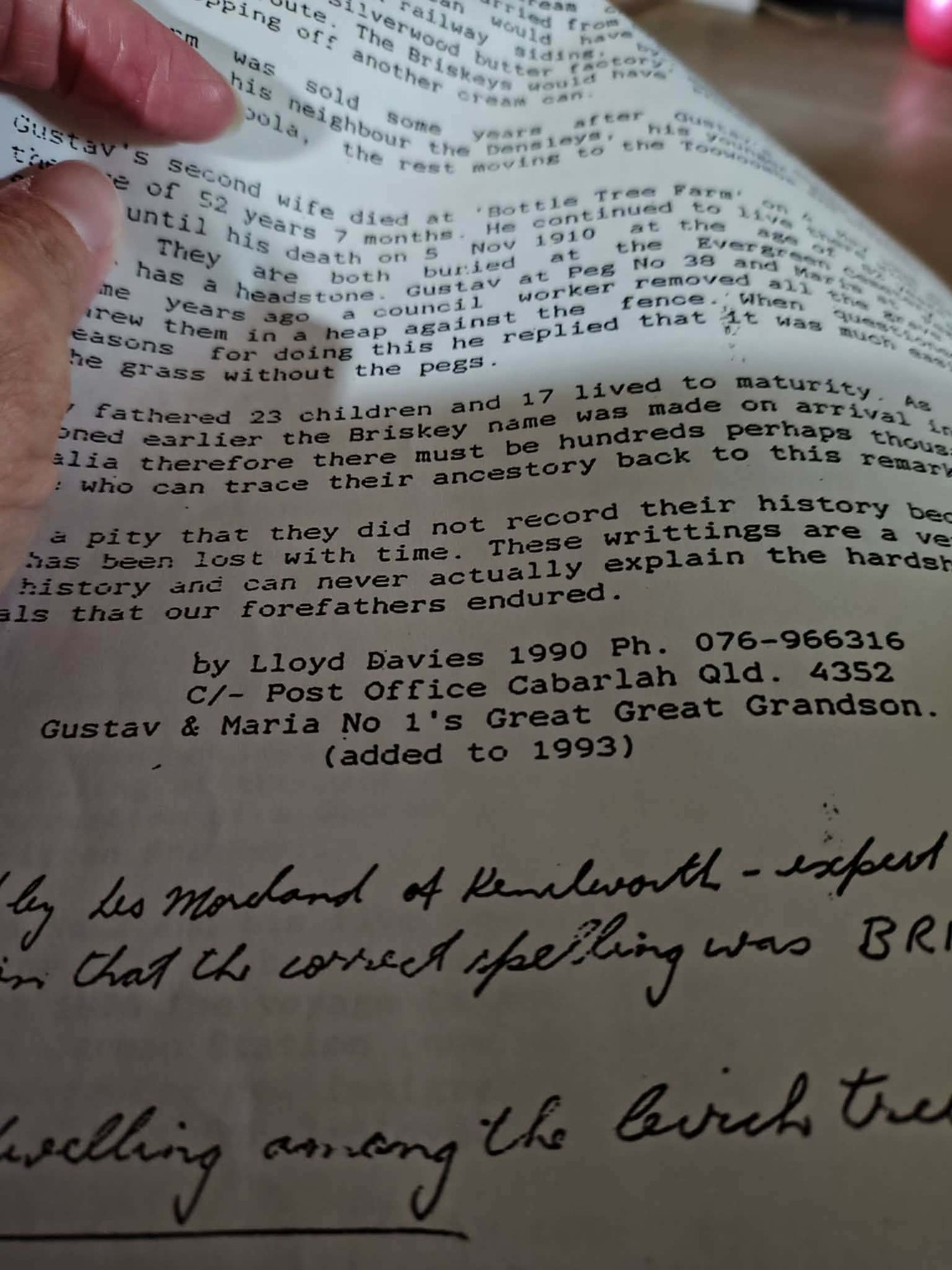
The transcript describes Bottle Tree Farm in the 1890s as isolated and largely self-sufficient. The family kept a dairy, pigs and poultry, killed their own meat, grew vegetables, and made butter and cheese. Water was carried from Myall Creek about a mile away.
Full cream cans were taken by cart or buckboard to Jondaryan railway siding, then by train to Toowoomba for the Silverwood butter factory. Empty cans returned by the same route.
Maria No. 2 died at Bottle Tree Farm on 4 May 1908, aged 52 years 7 months. Gustav remained there until his death on 5 November 1910, aged 82 years 8 months.
Both are recorded as buried at Evergreen Cemetery, Gustav at Peg No. 38 and Maria at Peg No. 27. Neither had a headstone. The transcript says the old grave pegs were later removed by a council worker.
Gustav fathered 23 children, with 17 living to maturity.
The earlier single-page extract has been replaced in this archive by the complete three-page family history supplied by the family.
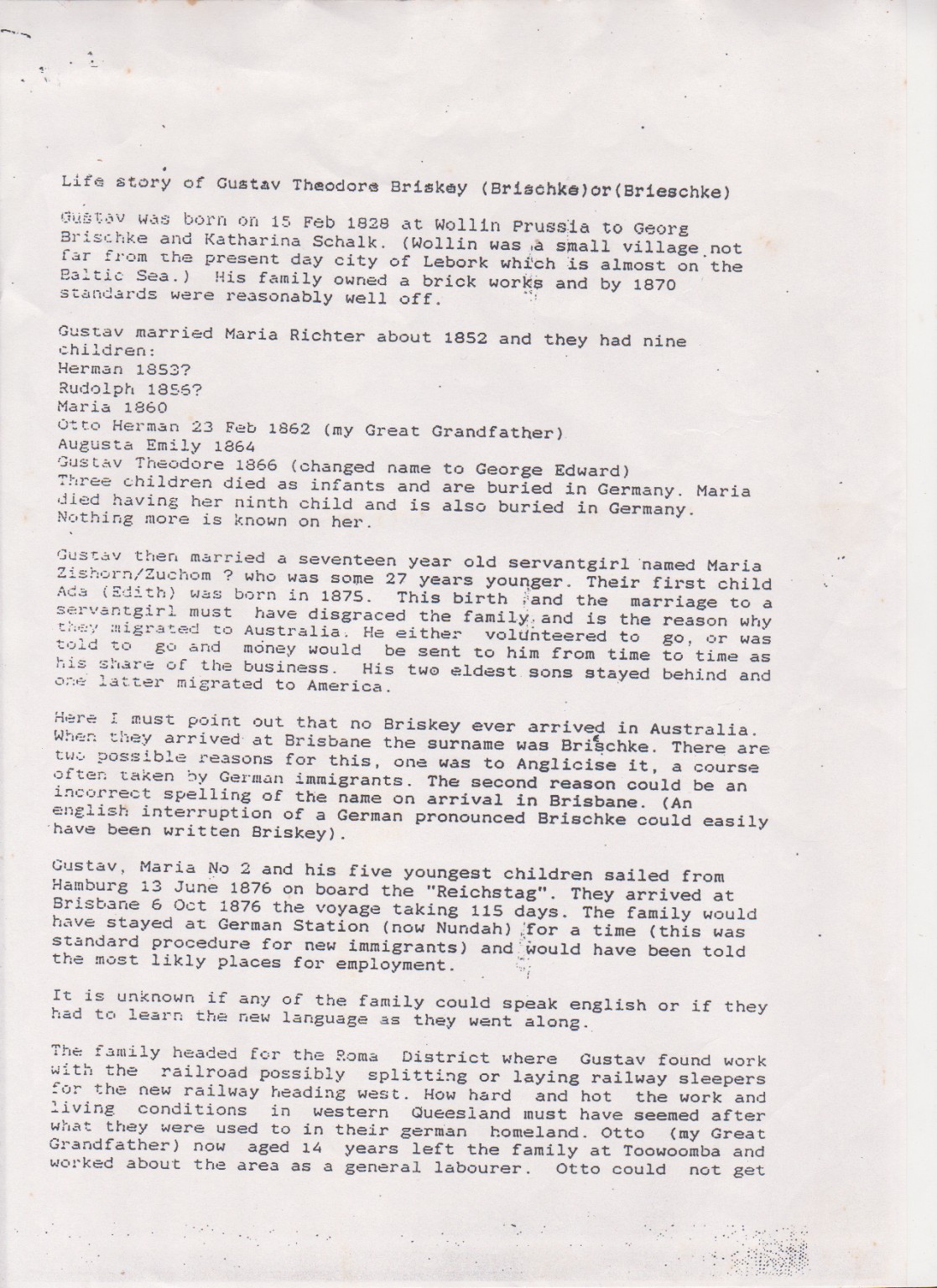
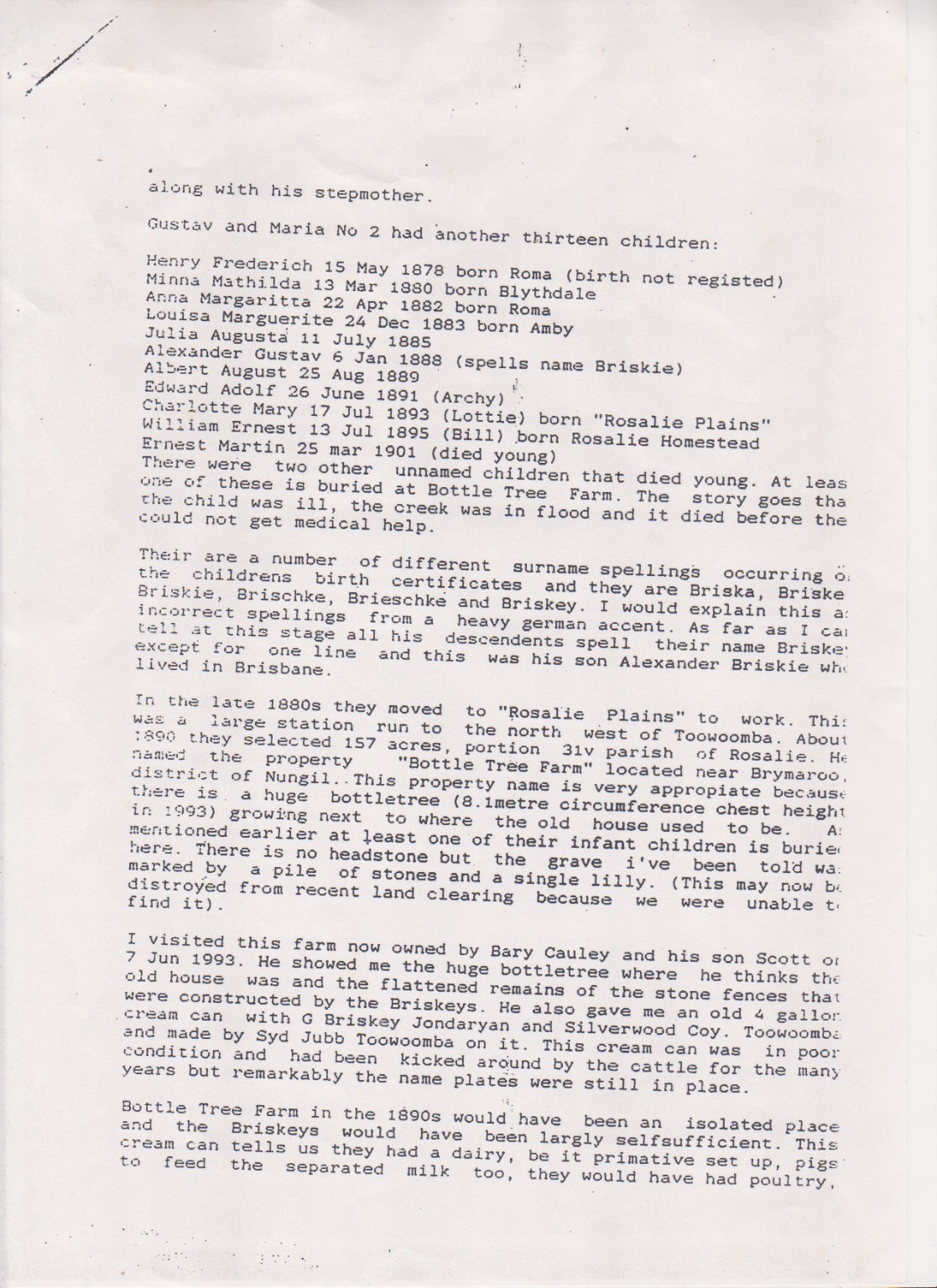
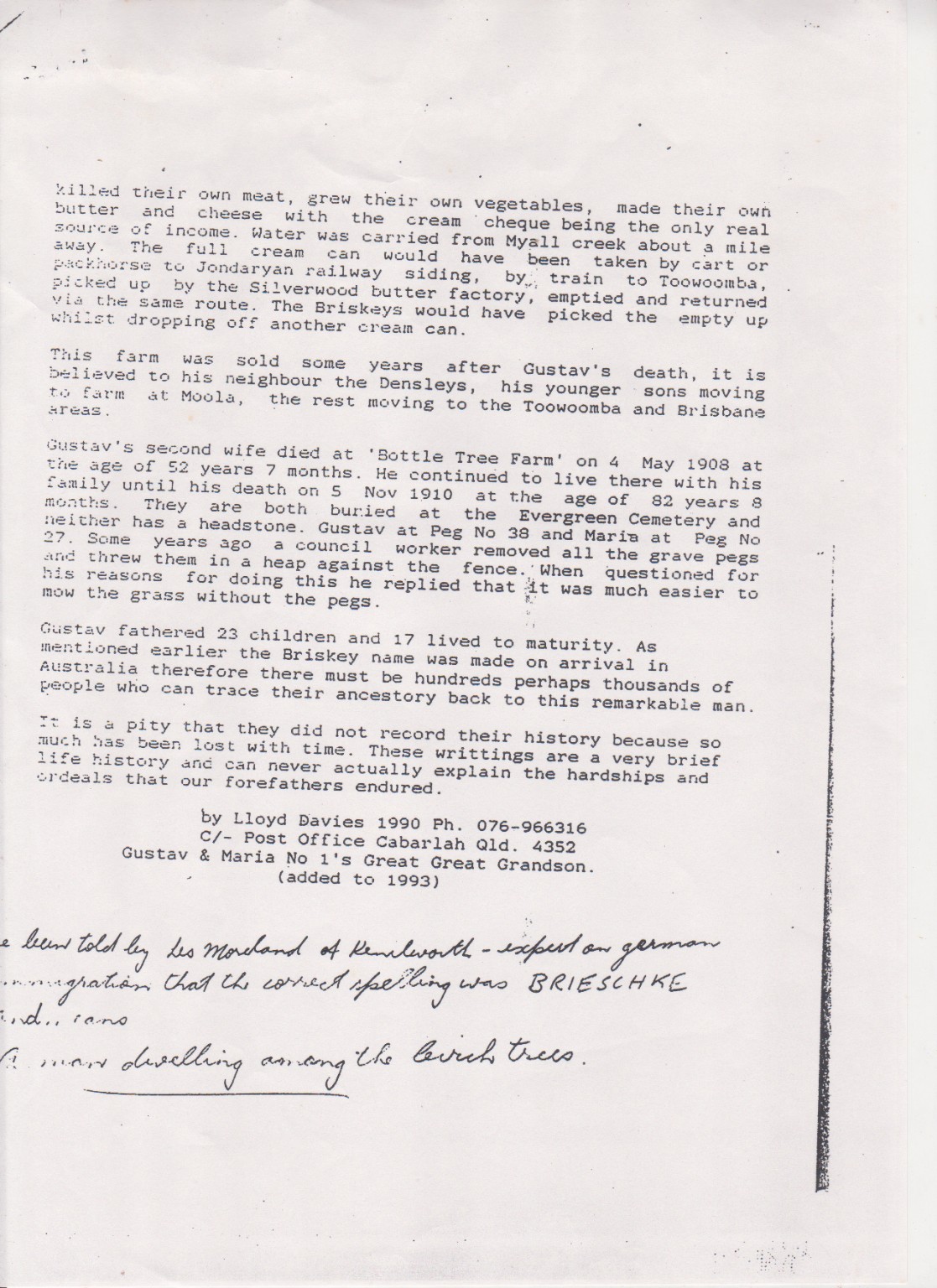
The original pages are reproduced as historical records. Some spellings and interpretations in the transcript are uncertain and have been preserved accordingly.
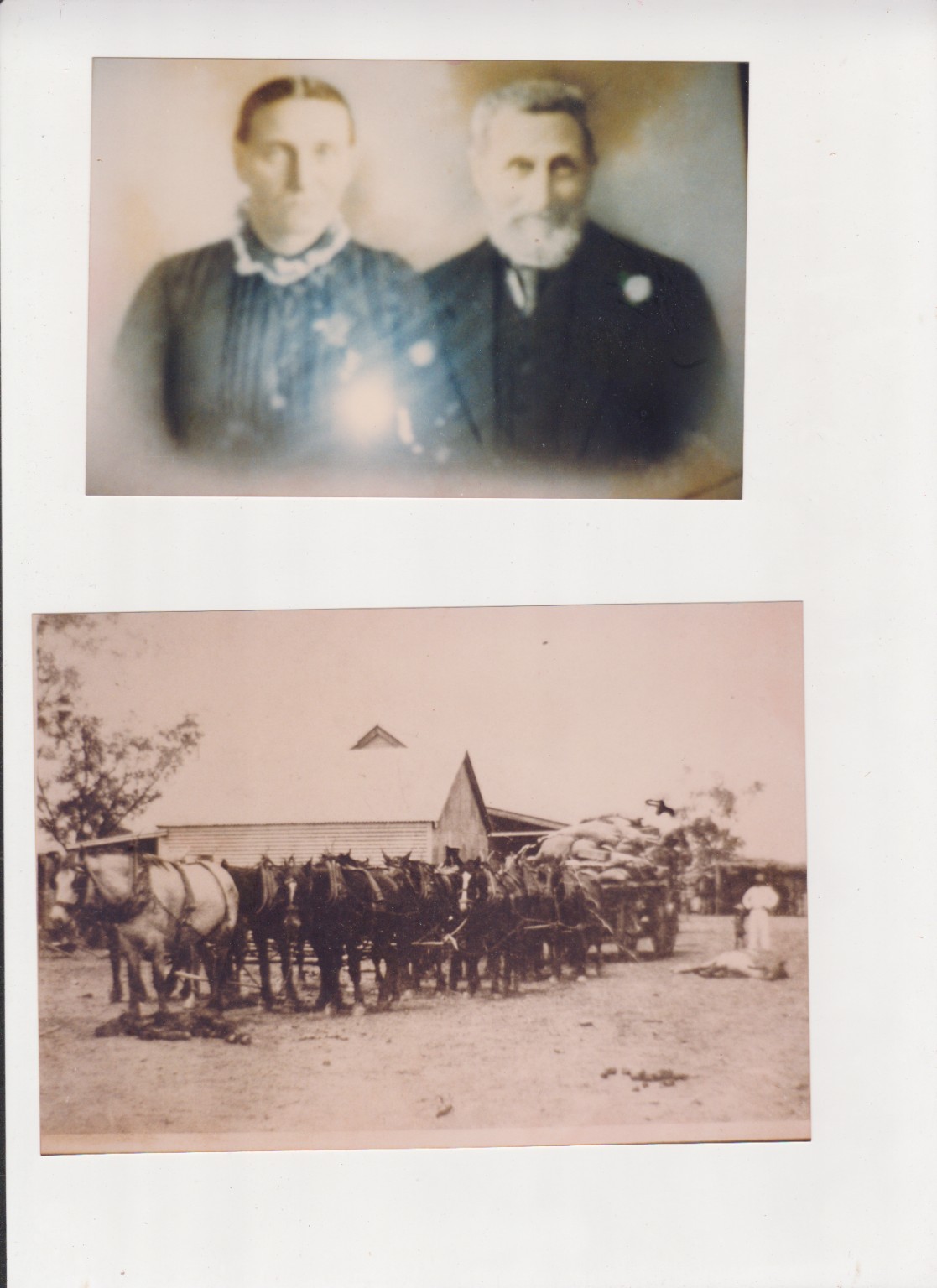
The upper photograph shows Maria and Gustav Briskey.
The lower family portrait shows Harry Briskey and Mary Ellen Smith with their children. Bessie is at the back; standing are Lilly and Arthur, with baby Charlotte.
These photographs help connect the early Australian Briskey generations with Arthur Frederick Briskey, who would later be one of the six brothers to serve during World War II.
This photograph shows Harry Briskey with his horse team at the old Donaldson Pub on the Cloncurry–Normanton Track.
It is dated 9 October 1910 and records the location as 53 miles from Cloncurry.
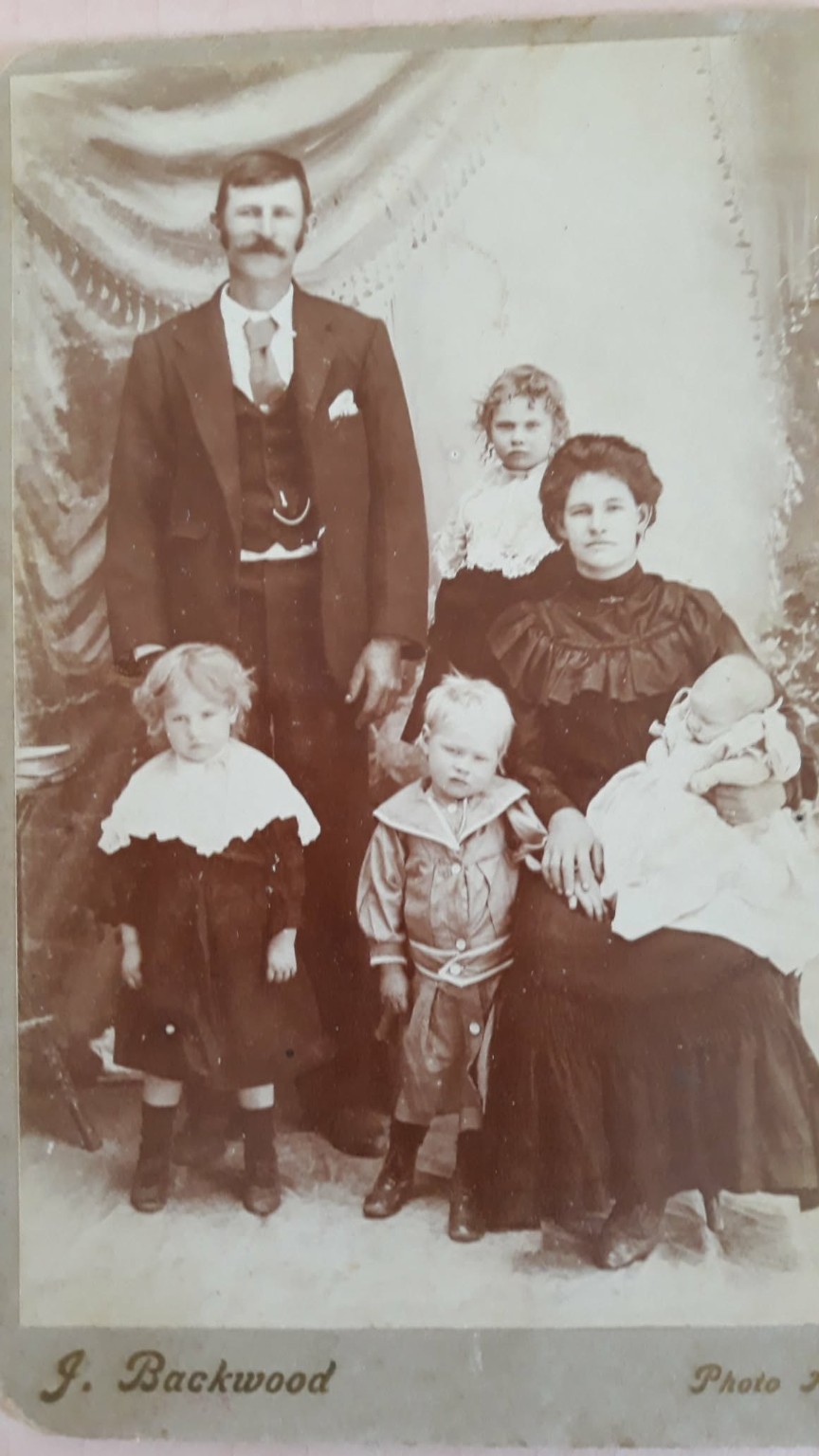
This early studio portrait shows Arthur Frederick Briskey with his parents and siblings. Arthur is the young child in the sailor-style dress/outfit in the centre foreground.
The names of the other children and Arthur's parents will be added when they are confirmed.
One family made an extraordinary contribution during the Second World War: six Briskey brothers enlisted for service.
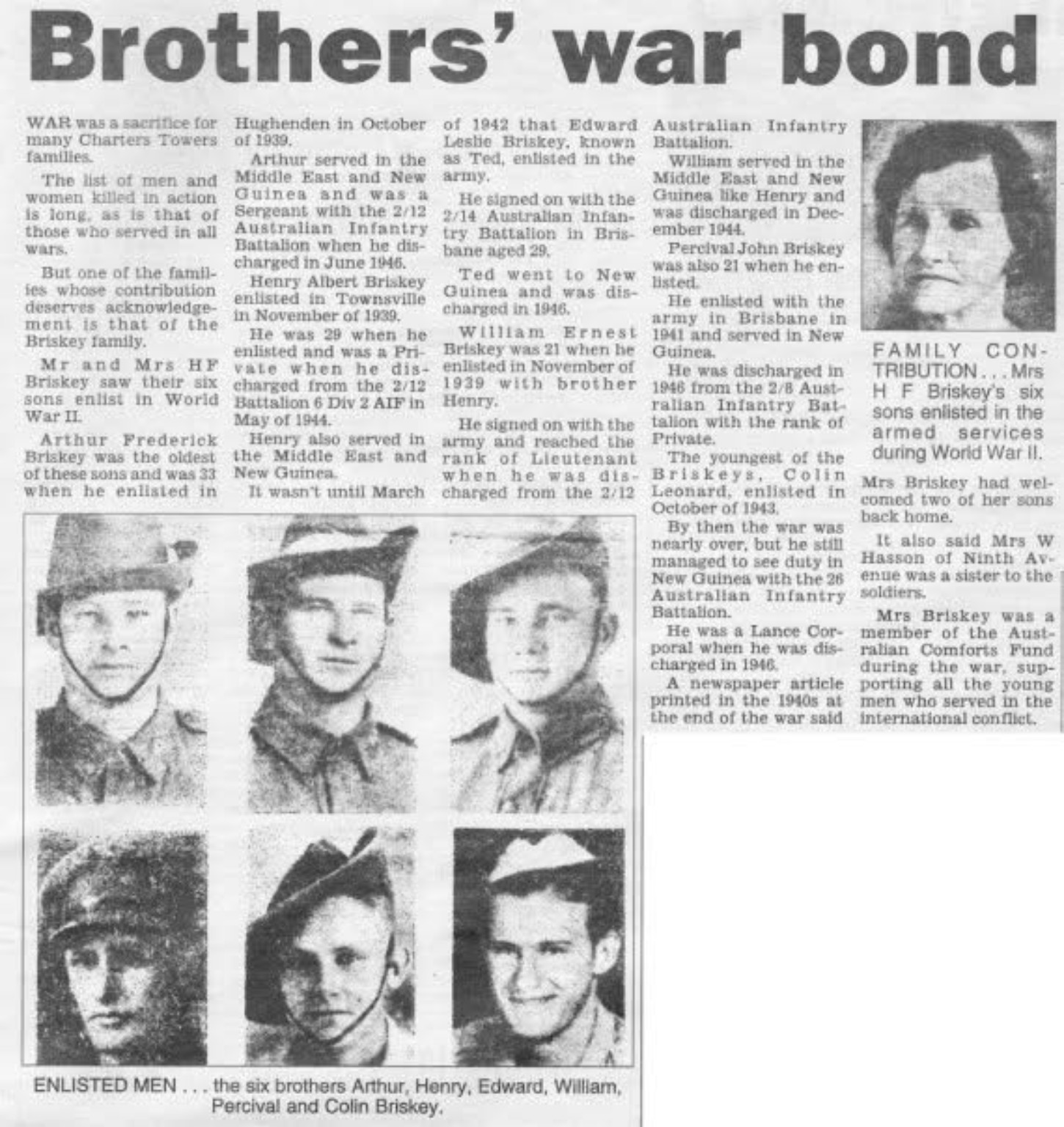
The surviving newspaper article names the six brothers as:
The article records service across the Middle East and New Guinea. Family information confirms that Edward Leslie was always known as Ted.
The eldest of the six sons. The newspaper account says he enlisted in October 1939, served in the Middle East and New Guinea, became a Sergeant with the 2/12 Australian Infantry Battalion, and was discharged in June 1946.
Enlisted in Townsville in November 1939. The article records service in the Middle East and New Guinea with the 2/12 Battalion.
Known in the family as Ted. The article says he enlisted in October 1942, joined the 2/14 Australian Infantry Battalion in Brisbane, went to New Guinea and was discharged in 1946.
The article says Ernie enlisted in November 1939 with the 2/12, signed on with the army, reached the rank of Lieutenant and was discharged in 1946.
Enlisted at age 21. The article records that he enlisted with the army in Brisbane in 1941, served in New Guinea and was discharged in 1946 from the 2/8 Australian Infantry Battalion with the rank of Private.
The youngest brother. He enlisted in October 1943 and later served in New Guinea with the 26 Australian Infantry Battalion. He was a Lance Corporal when discharged in 1946.
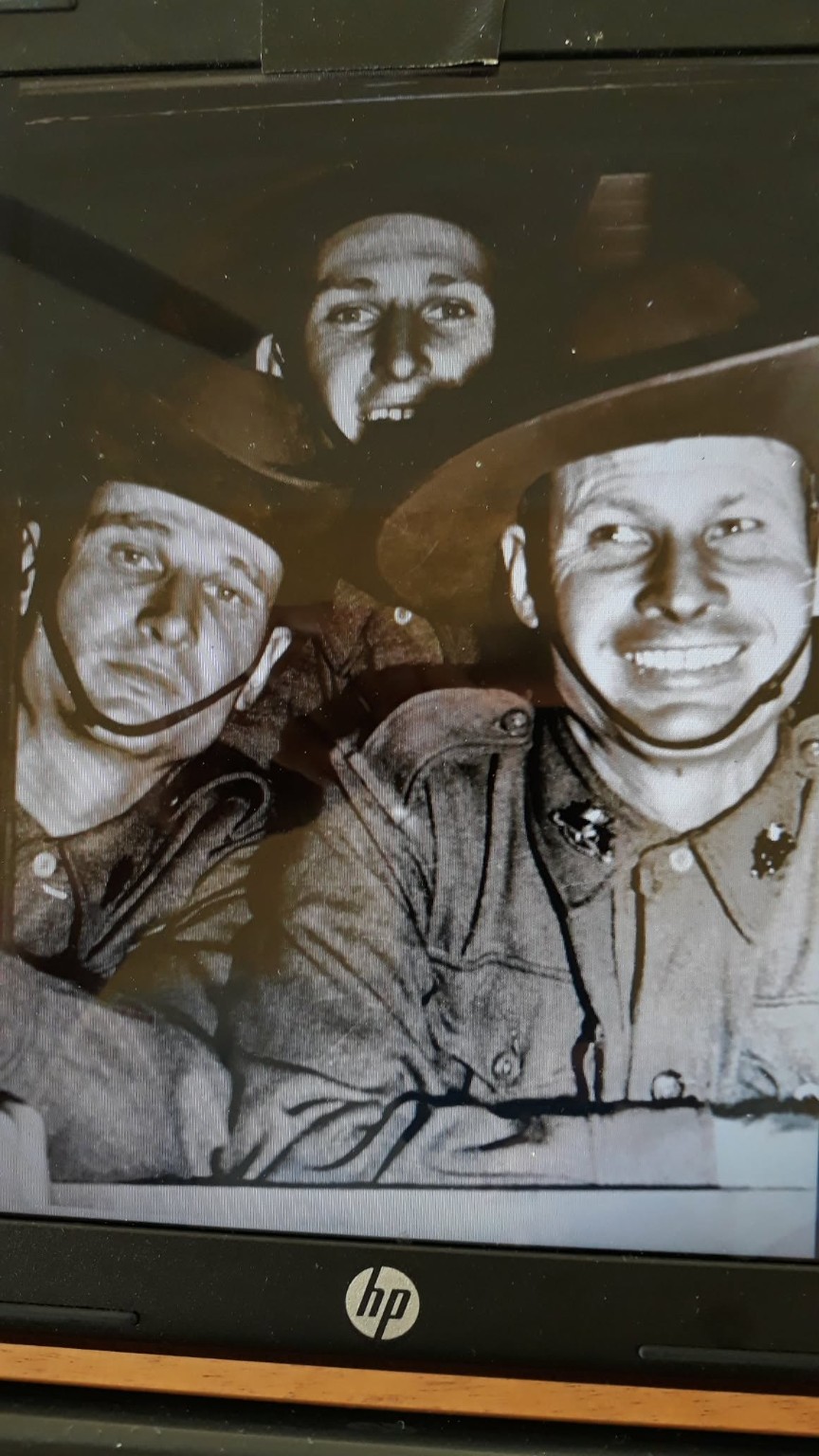
This family photograph shows Henry, Arthur and Ernie Briskey together aboard a train somewhere in Egypt during their wartime service.
Family history records that they were all at Tobruk. The precise location of the train photograph is not yet known, so it is preserved simply as “somewhere in Egypt.”
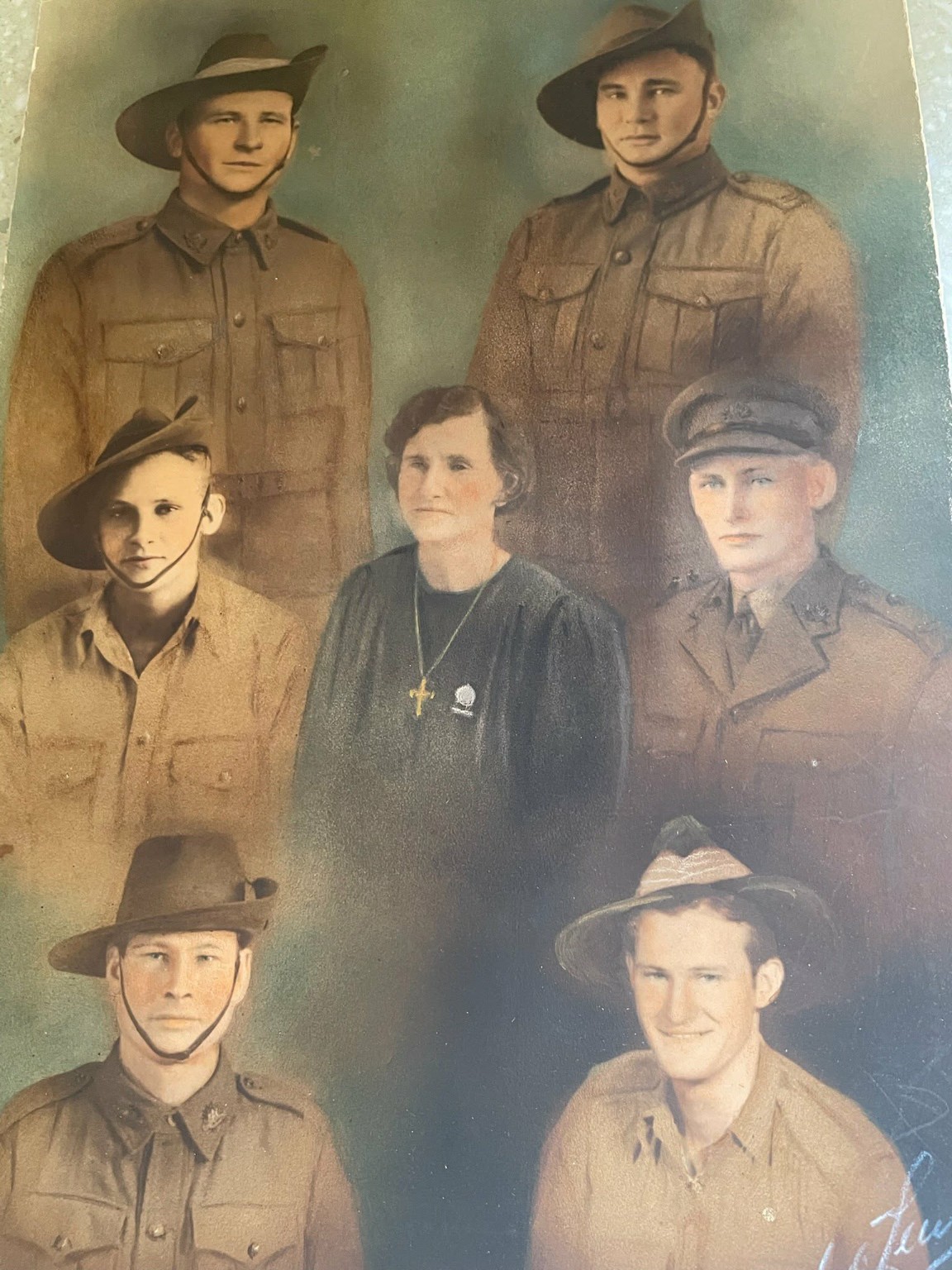
This hand-coloured family photograph brings together the wartime generation. The six servicemen surround their mother. It is preserved here alongside the newspaper account of the six Briskey brothers.
Individual faces will only be labelled when their identities can be confirmed from family records.
Born 15 February 1828 at Wollin, Prussia. Migrated to Australia in 1876 and later established Bottle Tree Farm near Brymaroo. Lloyd Davies' transcript records 23 children, 17 surviving to maturity.
Family photographs identify Harry Briskey and Mary Ellen Smith with their children Bessie, Lilly, Arthur and baby Charlotte. Harry is also pictured with his horse team at the old Donaldson Pub on the Cloncurry–Normanton Track on 9 October 1910.
Arthur is identified in childhood family photographs and later became one of the six Briskey brothers who enlisted during World War II.
Arthur Frederick, Henry Albert, Edward Leslie “Ted”, William Ernest “Ernie”, Percival John and Colin Leonard Briskey — six brothers who enlisted during World War II.
This tree is intentionally conservative: relationships and names not yet confirmed are not guessed.
Historic portrait.
Maria and Gustav; Harry Briskey and Mary Ellen Smith with Bessie, Lilly, Arthur and baby Charlotte.
Harry and his horse team at the old Donaldson Pub, 53 miles from Cloncurry.
Arthur in the centre foreground with his parents and siblings.
Henry, Arthur and Ernie aboard a train.
The six servicemen with their mother.
Newspaper clipping documenting the wartime contribution of the six Briskey brothers and their family.
The complete three-page family history written by Lloyd Davies in 1990 and added to in 1993, covering Gustav Theodore Briskey, migration to Australia, the family, Bottle Tree Farm and later years.
Personal contact details printed on the historical document are not reproduced as searchable text on this site.